“Pink goes well with green!”
“It so does!”
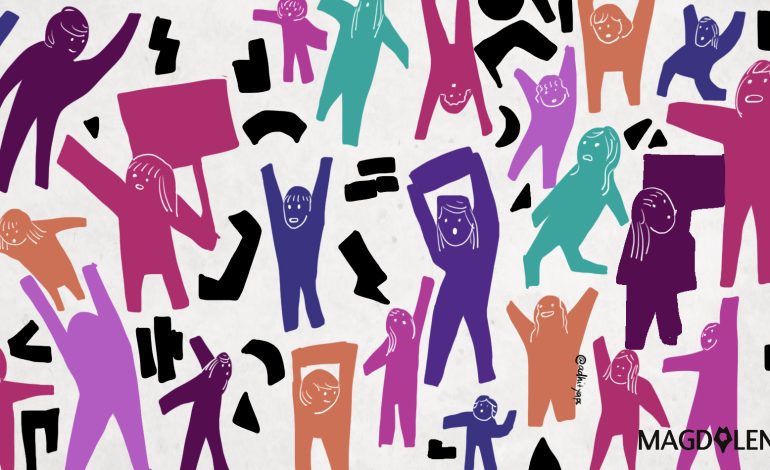
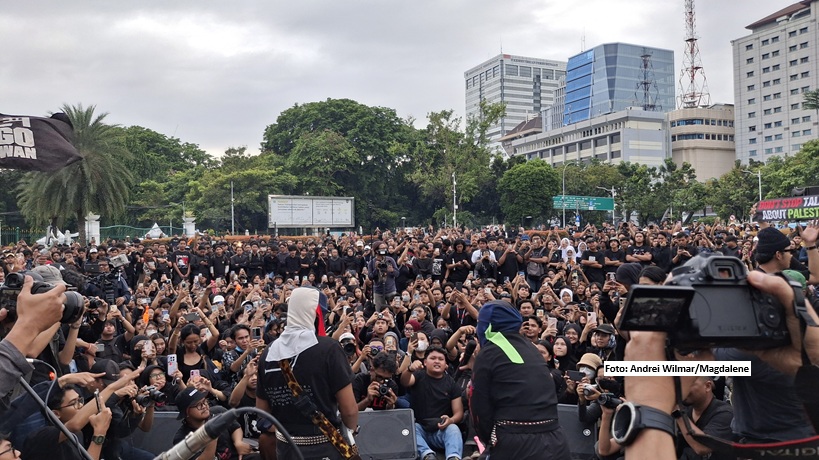
These iconic lines from the musical Wicked (2003) have taken on new meaning in the streets of Indonesia. Amid political tension and social unrest, two colors—pink and green—have emerged as a bold visual language of protest. In what has become known as the Brave Pink and Hero Green movement, Indonesian protesters have harnessed color coordination to signal solidarity, amplify dissent, and reframe narratives of gender, class, and resistance.

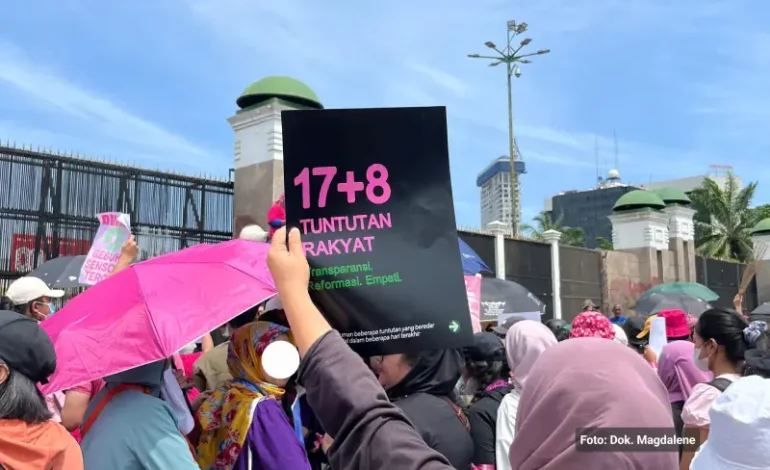
Pink, long coded as soft and feminine, has been reclaimed as a symbol of courage. The transformation began with Ibu Ana, who went viral for waving the Indonesian flag in her pink hijab in front of a line of Mobile Brigade officers during a heated protest in Jakarta. The moment was instantly iconic—her hijab became known as “Brave Pink,” a hue that now signals women’s fearlessness in the face of repression.
This subversive use of color echoes past women-led protests in Indonesia, such as Aksi Kamisan, where mourners, dressed in black and holding black umbrellas, have gathered every Thursday for over two decades to demand justice for victims of state violence. Initiated by women like Maria Katarina Sumarsih—mother of the 1998 Semanggi I victim Bernadinus Realino Norma Irawan—and Suciwati, widow of murdered activist Munir Said Thalib, Kamisan represents a different kind of female resilience: quiet, consistent, and uncompromising in its moral clarity.
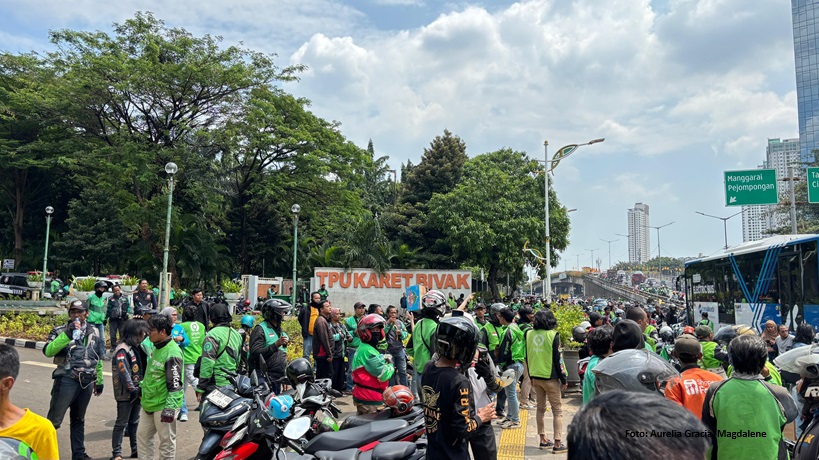
If Brave Pink is about courage in confrontation, Hero Green embodies the sorrow and strength of the working class. It honors the memory of Affan Kurniawan, a 21-year-old motorcycle taxi driver who was fatally crushed by a police armored vehicle during the same protest. His green uniform, ubiquitous among gig workers, has become a symbol of the “rakyat kecil”—the everyday people who keep Indonesia running, yet are often rendered invisible in political discourse. Hero Green transforms their labor and loss into a visible call for justice.
Together, pink and green form a striking palette—both playful and somber—that represents empathy, grief, resistance, and collective hope.
Also read: Indonesia’s Digital Counterrevolution: How Authorities Outsmarted Social Media Uprisings
The flawed hero and the politics of purity
While Hero Green’s symbolism rests on a martyr, Brave Pink’s association with a living figure, Ibu Ana, has proven more fraught. Soon after her viral moment, an older video surfaced showing her making controversial remarks about regime change and encouraging disruptive protest tactics. Almost overnight, public adoration gave way to suspicion, mockery, and outrage.
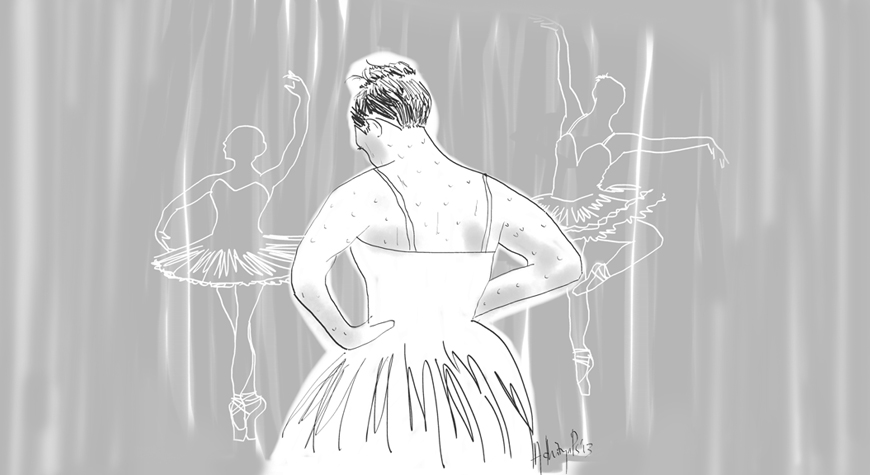
This whiplash response reveals a deep cultural longing for infallible heroes and the backlash when they inevitably fail to meet idealized standards. The scrutiny directed at Ibu Ana, criticizing her emotional tone and coarse language, mirrors attacks faced by global figures like Greta Thunberg. Both are women operating outside conventional norms of civility, whose passion and refusal to conform are reframed as personal pathology.
These critiques draw from an old playbook. The trope of the madwoman—hysterical, irrational, unstable—has long been used to dismiss women who speak inconvenient truths. The issue becomes not what is said, but how it is said and by whom.
But as political anthropologist James C. Scott argues, there’s a difference between the “public transcript” (the sanitized language used in front of power) and the “hidden transcript” (the raw, honest grievances voiced offstage). Ibu Ana’s unfiltered speech wasn’t irrational; it was a breach of the hidden transcript into the public sphere. Her “crudeness” wasn’t a flaw—it was a political rupture.
Such ruptures can be electrifying but also destabilizing. They unsettle the decorum of protest and risk alienating those who prefer tidy narratives. Social media, ever reactive, turned against her. Her image as a national mother figure clashed with the messiness of her real voice. This reveals a problem with hero-centric activism: when the movement’s energy is tethered to a single figure, that movement becomes vulnerable to personal takedown. But 2025’s wave of protests has shown signs of moving beyond such fragility.
Also read: When Parliament Dances, the People Mourn
The rise of decentralized protest
Contemporary movements in Indonesia, like elsewhere, are increasingly rhizomatic: decentralized, adaptive, and driven by many small nodes rather than one central root. The strength of this networked approach is that no single individual can discredit or derail the cause once a movement has become a self-sustaining network of many nodes. Its vitality is not determined by the perfections of its origins but by the resilience of its connections.
Even as Ibu Ana’s symbolic power waned, the movement surged forward. Within days, rallies across Indonesia and in the diaspora—Melbourne, Seoul, London, Paris, Amsterdam—carried the 17+8 Tuntutan Rakyat banner. These “17+8 Demands,” referencing Indonesia’s Independence Day, emerged as a shared platform blending civic discontent with policy demands.
These demands weren’t issued by any one leader, but were compiled, refined, and circulated organically through social media and WhatsApp groups. Digital flyers in pink and green colors spread rapidly, bringing coherence to a multi-headed movement. The distributed nature of this activism makes it harder to suppress and easier to sustain if it stays rooted in the communities it claims to represent.
Yet questions remain. Can such a leaderless movement yield systemic reform? Will these demands survive the news cycle and turn into tangible wins? The answer depends on how persistently citizens push and how collectively they hold power to account beyond the performative aesthetics of protest.
The Brave Pink and Hero Green protest is not perfect. Nor are its people. And that’s exactly the point. Resistance does not require saints, it requires solidarity. What makes the movement powerful is not the purity of its heroes, but the honesty of its imperfection.
In reclaiming pink and green, Indonesians have not only challenged repression but rewritten the emotional script of dissent. This is a movement that knows how to grieve and organize, to be both whimsical and wicked. And if its colors are any indication, its strength lies in being beautifully human—even when flawed.
Siti Sarah Muwahidah is an Indonesian scholar at the University of Edinburgh, where she researches religion, conflict, and peacebuilding. Her work explores the intersections of identity, faith, politics, and power across Southeast Asia, the UK, and the US.