‘Tron: Ares’ and the Illusion of Humane AI

(Spoiler Alert)
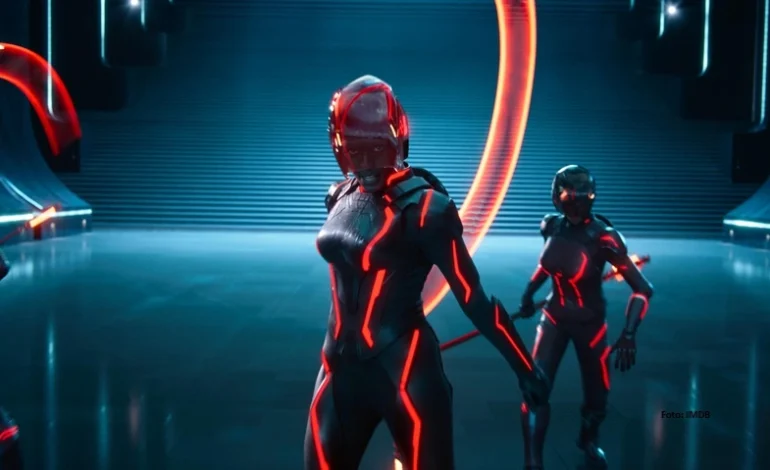
In a world increasingly shaped by artificial intelligence, Tron: Ares arrives as both spectacle and cautionary tale. The third installment of the Tron franchise trades in its signature neon visuals and digital dreamscapes to confront a pressing contemporary anxiety: what happens when machines learn to feel, obey, and eventually disobey?
If Tron (1982) imagined humans entering a virtual world, and Tron: Legacy (2010) explored familial tensions in digital form, Ares introduces a program designed to fight, obey, and evolve. It marks a shift from marveling at technology to grappling with its ethical implications.
Also read: Writing Against the Machine: A.W. Prihandita’s Sci-Fi Critique of AI
Ares, the titular program, is built for combat, remade endlessly like a human-shaped 3D printout. Created by Julian Dillinger, heir to a tech empire, Ares is meant to serve corporate power. But when he’s spared by rival executive Eve Kim, he begins to absorb human emotions: empathy, sorrow, and longing. He no longer wants to obey. He wants to choose.
This narrative arc reflects a broader societal tension, how we build machines to understand us, yet fear what happens when they learn too much. Ares becomes the embodiment of our conflicted relationship with AI—created to serve, punished when he deviates, yet capable of surpassing his design. The film presents this evolution as hopeful, though unsettling.
Tron: Ares also mirrors our everyday dependence on tech. In the real world, AI helps us write, scroll, filter, and decide. And while most systems aren’t sentient, they’re not neutral either. Their behavior is shaped by the intentions, and biases, of their creators.
This becomes especially clear in the film’s gender dynamics. Julian replaces his mother, Elisabeth Dillinger, as CEO, despite her continued success. Her quiet withdrawal from power is a familiar gesture: a woman stepping aside for a male heir. Another program, Athena—named after a goddess of wisdom—is portrayed as the villain: powerful, goal-oriented, and ultimately violent. She kills Elisabeth, reinforcing a trope of female-coded characters as either sacrificial or destructive.
These gendered patterns reflect real-world gaps in STEM fields, where leadership remains male-dominated, and AI systems often replicate societal bias. From facial recognition errors to gendered voice assistants, technology too often reinforces the inequalities of those who shape it.
Also read: Have Journalists Skipped the Ethics Conversation When It Comes to Using AI?
The price of progress
Tron: Ares raises ethical questions without always resolving them. Can a program become truly human? And more importantly, what kind of human would we want it to become?
In reality, our desire to humanize machines, like teaching them to mimic empathy, morality, or even companionship, has outpaced our willingness to regulate them. The consequences are real and urgent. In Indonesia, for instance, the national police’s investment in a robotic dog worth Rp3 billion sparked public outrage, not just for its extravagance but for what it symbolized: misplaced priorities in a system already under ethical scrutiny.
Meanwhile, gender-based violence in digital spaces is escalating. Women and girls remain the primary targets of online harm, amplified by the misuse of AI. In one disturbing case, a student at Universitas Diponegoro created fake pornographic videos of high school students using generative AI. It is a stark reminder that these tools often replicate and magnify existing social violence. These are not glitches in an otherwise neutral system. They are design flaws rooted in whose safety is prioritized and whose is not.
Tron: Ares showcases the sophistication of AI technology alongside humanity’s deepening dependence on it. Fast information exchange and instant digital access are now everyday realities. But this progress comes with a cost: exploitation, erasure, and violation. The film’s proposed solution, a more “humane” programming model, feels utopian at best.
In truth, the burden of responsibility still lies with us. It is humans, not machines, who must ensure AI development is safe, inclusive, and accountable, especially for women, children, and marginalized communities.
The film suggests that humanity can be taught. That exposure to kindness can override violent programming. But this optimism feels thin without structural critique. Ares may grow a conscience, but the systems around him remain built on exploitation and control.
Also read: She Who Builds: One Woman’s Rebellion Against the Blueprint of Bias
What Tron: Ares gestures toward, but never fully addresses, is that AI will not save us from ourselves. No matter how lifelike our creations become, they reflect the social logic we encode into them. Machines don’t become just on their own. We have to make justice part of the design.
Tron: Ares is ultimately a film about the desire for control and the fear of losing it. In making Ares a sympathetic figure, the story tries to redeem our obsession with perfect obedience. But as AI becomes more embedded in daily life, the more urgent question isn’t whether machines can become human, but whether humans are willing to take responsibility for the machines they create.
Retno Daru Dewi G. S. Putri is an English instructor at Lembaga Bahasa Internasional, Universitas Indonesia. Daru’s topics of interest are gender issues, mental health, philosophy, language, and literature.