Feminism is far older than the timeline we use to describe it. The familiar “waves” capture only part of a history of resistance that stretches back centuries. Yet academia still struggles to practice the equality it so readily discusses. Progressive ideas get brushed off as babble, and everyday put-downs survive as tradition. Universities hold panels on women’s bodies, analyze them through theory, and celebrate them as symbols of resistance and empowerment. The talk never stops. Listening is another matter.
The contradiction is institutional: universities can condemn women’s oppression in their scholarship while tolerating it in classrooms, departments, and complaints procedures. Knowing the language of equality does not guarantee a willingness to act on it. Academic progress is no proof that the institution itself has become fairer.
It is discussed in panels, analyzed through theories, and became a symbol of women’s resistance and empowerment. While the talk was endless, there were never enough ears. This is collective cognitive dissonance in academia. Academia condemns the oppression of women while committing it in constant subtle gestures, a contradictary move to the presupposed fundamental progression in human civilization.
Read also: Olivia Rodrigo and the Expiration Date of Female Likeability
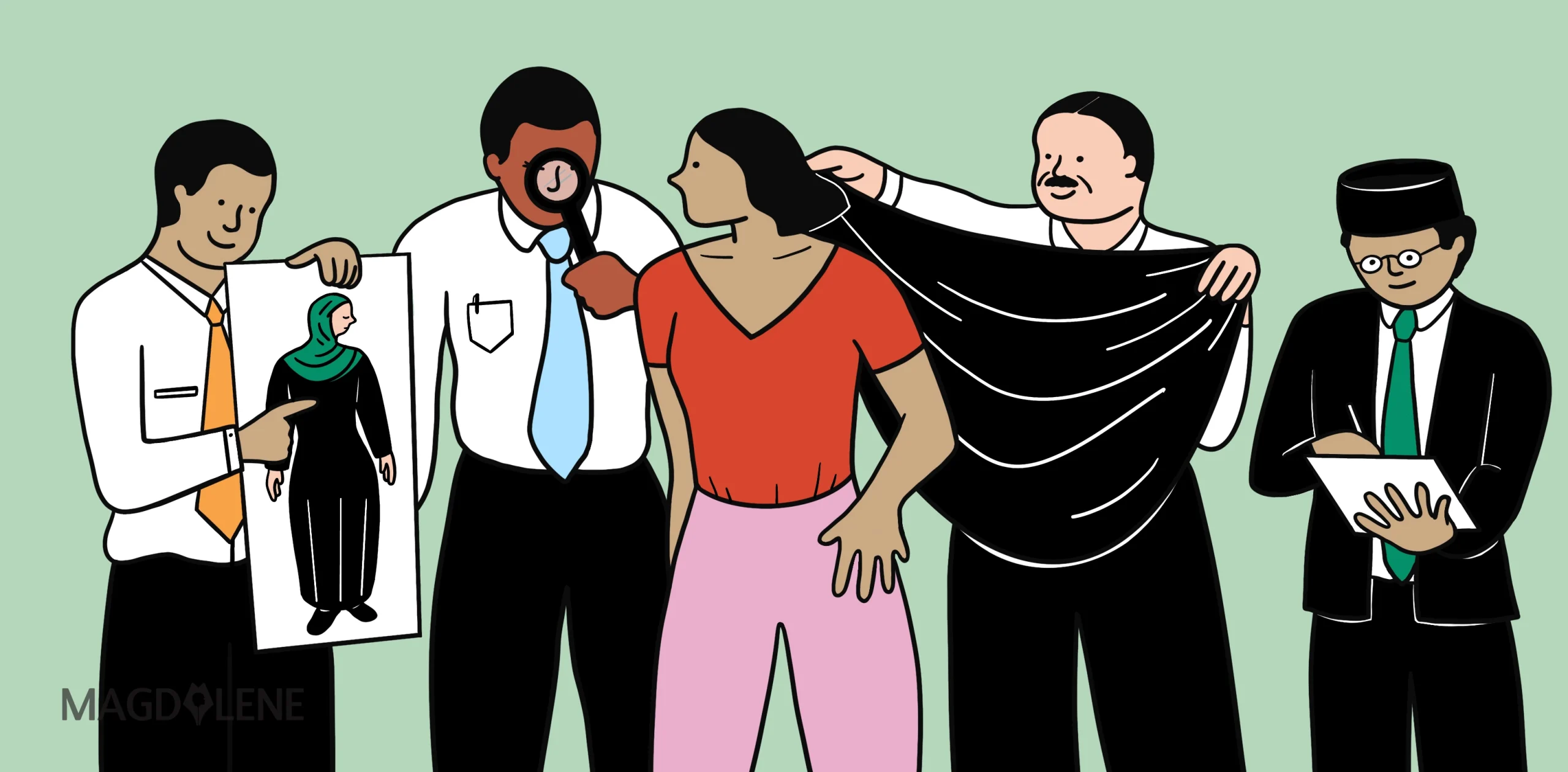
Feminist concepts such as the male gaze and intersectionality have helped expose how women are objectified and how gender interacts with race, class, and sexuality to shape discrimination. But even this vocabulary can become detached from the lives it is meant to illuminate. Repeated often enough, “the female body” risks becoming an abstraction: something to interpret rather than someone’s body, carrying pain, desire, fear, and memory.
That distance becomes harder to ignore when discussions of women’s struggles are met with sexual jokes, women scholars find their credibility questioned, or harassment complaints are treated as threats to an institution’s reputation. The people whose experiences sustain an entire field of study can still struggle to be heard within it.
In Indonesia, the National Commission on Violence Against Women (Komnas Perempuan) reported that universities accounted for 42 of the 97 complaints of sexual violence in educational settings recorded for 2020–2024—the largest share among the educational categories listed. These are reported cases, not a measure of the full extent of violence. The commission also identifies unequal power relations, social pressure, and concerns about reputation as barriers to reporting.
The gap between universities’ stated commitments and women’s experiences is not confined to Indonesia. Cases at elite U.S. institutions show that academic prestige offers no immunity from failures of accountability.
In 2012, Yale agreed to strengthen its response to sexual misconduct complaints following a federal investigation that documented weaknesses in complaint coordination. The agreement did not constitute a formal finding of noncompliance. At Stanford, Brock Turner’s six-month jail sentence following his 2016 sexual assault conviction sparked outrage over its leniency; the university had permanently barred him from campus. Yet in October 2026, The Stanford Daily reported that a separate complaint took two years to reach a disciplinary outcome—a two-year suspension. Stanford acknowledged that its process “can take too long.
At Cornell, a September 2026 lawsuit challenged the university’s handling of an alleged 2024 sexual assault involving fraternity members. The accused denied the allegations. Cornell said it had imposed suspensions and expulsions, and later announced further reforms and an independent review. These cases differ, but expose a shared tension between institutional promises and the struggle to secure accountability.
Teaching bodily autonomy means little if students cannot safely report violations of it. Researching sexual violence should sharpen an institution’s sense of responsibility toward survivors. When scholarship and institutional practice remain disconnected, women’s experiences become material for academic work without prompting accountability.
Read also: When the Men Leave, Women Hold Up the Fields—But Structural Injustice Remains
When Feminist Critique is “too Personal”
The contradiction extends to how women are allowed to speak. Feminist critique is welcomed as an intellectual exercise, then dismissed as “too personal” when someone describes discrimination she has experienced herself. Anger becomes evidence against the speaker rather than a reason to examine what happened.
Rigor matters, but rigor and emotion are not opposites. Personal testimony can be questioned and situated without being dismissed, and an argument does not lose its substance because its author is angry. Women, especially women of color, and queer scholars should not have to strip their accounts of feeling before those accounts become worthy of discussion.
The hierarchy also shapes how academic disciplines are valued. Fields associated with masculinity, particularly parts of STEM, are often described as “hard,” while feminized disciplines are treated as “soft.” These labels can turn differences between fields into assumptions about the intelligence of the people working in them. Gender enters the judgment before anyone has solved an equation or read a poem.
Even the humanities have their own exclusions. Histories centered on war, rulers, and high politics have often left less room for women’s intellectual and everyday lives. Who appears in the record depends partly on what historians consider worth recording and teaching.
Enheduanna offers a useful reminder. A high priestess and poet in Mesopotamia around 2300 BCE, she is widely recognized as the earliest author known by name. Her work complicates any account that treats women as late arrivals to intellectual life. The question is not whether women produced knowledge, but how their contributions are preserved, recognized, and passed on.
The struggle over recognition also appears in The Wife (2017), in which a celebrated novelist’s reputation rests on work written by his wife. The film concerns literary prestige rather than academic life, but its central question resonates: who gets to produce knowledge, and who gets the credit? It shows how a woman’s exclusion can help sustain the very reputation that overshadows her.
Read Also: Sometimes I Lie About My Age—It’s Easier Than Explaining Myself
A Societal Failure, Not a “Women’s Issue”
These patterns reinforce one another. Women’s experiences supply the subject matter, while their authority to interpret those experiences remains conditional. Their work is discussed, but their anger is inconvenient. Their bodies are theorized, but their complaints can still be dismissed.
This is a societal failure. Women should be able to pursue their chosen fields without also having to prove that discrimination exists or repeatedly campaign for their own safety. Challenging sexism cannot remain an extra, unpaid responsibility assigned to those who endure it.
For universities, listening must have consequences: taking complaints seriously, examining how credibility and credit are distributed, and accepting that feminist critique can be both rigorous and personal. An institution cannot claim to value women’s knowledge while refusing to hear what women say about life inside it.
Until academia listens as seriously as it talks, the panels will keep filling up—and the women whose lives give those discussions meaning will still be waiting to be heard.
Illustration by Karina Tungari