When the Men Leave, Women Hold Up the Fields—But Structural Injustice Remains

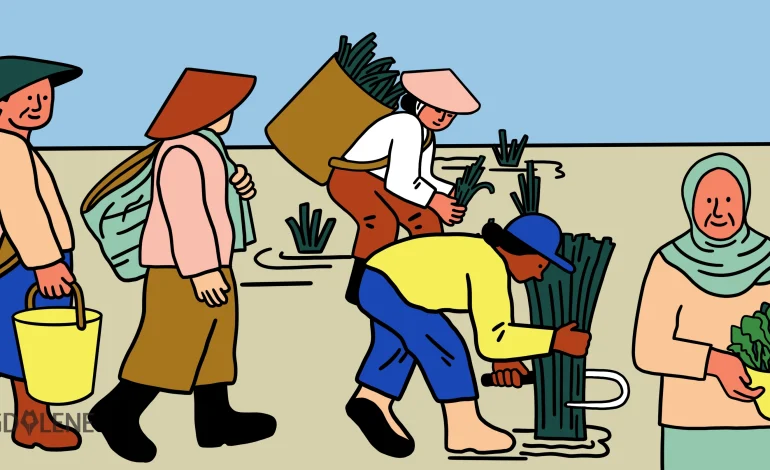
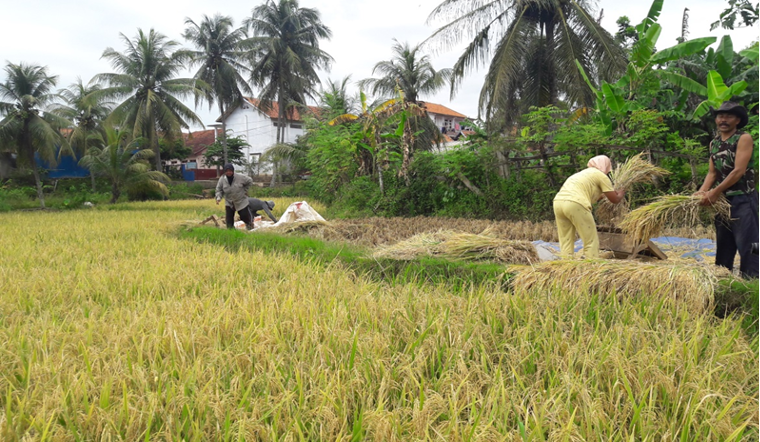
In Sirnabakti Village, Garut, West Java, the workday for many women begins long before sunrise. They wake at three in the morning, prepare meals, get children ready for school, finish the first round of household chores, and only then head to the rice fields. By the time they return home in the afternoon, their work is far from over. Domestic responsibilities resume in the evening, sometimes accompanied by side jobs to stretch household income a little further. In this village, women’s labor does not move neatly between home and work. It overlaps, extends, and accumulates.
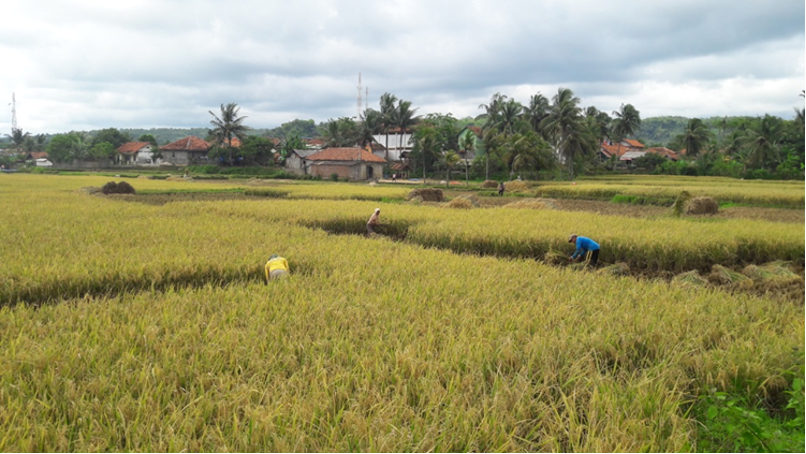
Sirnabakti Village, where I conducted my undergraduate research, offered a striking picture of this reality. In 2018, the number of female laborers in the village reached 1,352, exceeding the number of male laborers, which stood at 1,184. According to Rokayah, who had worked as a female farm laborer for more than fifteen years, many men of productive age had moved to larger cities such as Bandung or Jakarta and shifted into non-agricultural sectors, including online motorcycle taxi work and construction labor. As men’s labor became more mobile, agricultural production in the village came to rest increasingly on women’s shoulders.
Yet this number did not translate into better welfare. Most women farmers in Sirnabakti are landless or own only very small plots, forcing them to sell their labor to wealthier landowners. They may be central to agricultural production, but structurally they remain in a weak bargaining position. Their labor is indispensable, but their access to assets, wages, and recognition remains limited.
This contradiction reminds me of Silvia Federici’s argument in Caliban and the Witch (2004). Under capitalism, technological development has systematically devalued women’s labor while intensifying the exploitation of their bodies. Her words came back to me while listening to women in Sirnabakti describe lives shaped by both paid agricultural work and unpaid care work. The village economy depends on women, but it does so without dismantling the inequalities that organize their labor.
Lise Vogel’s social reproduction framework in Marxism and the Oppression of Women (1983) helps make sense of this. Capitalism depends not only on the production of goods and surplus value in formal workplaces, but also on unpaid reproductive labor in the domestic sphere, much of it performed by women. This includes giving birth to and raising the future workforce, meeting the daily needs of working family members, and caring for those outside productive age, including children and elders. Gender oppression, in this sense, is not accidental. It is embedded in the very logic of how labor is reproduced.
That logic is clearly visible in Sirnabakti Village. Women work as mothers, care workers, and wage laborers at once. Hasnah, a 38-year-old female laborer, told me, “Women are considered more attentive in maintaining the quality of rice, while the heavier tasks in agriculture are usually undertaken by men.”
On the surface, this sounds like recognition of women’s skills. In practice, it channels women into lower-paid agricultural tasks and reinforces the idea that their labor should remain flexible, cheap, and secondary.
Also read: From Heaven to Dining Table: How Women Religious Community Drives Green Revolution
Women farmers are paid less, burdened more
The wage gap makes this explicit. In Sirnabakti Village, men are paid around Rp55,000 a day for tasks such as hoeing and plowing, while women receive approximately Rp35,000 for planting and harvesting. This is a clear gender-based disparity in agricultural wages. At the same time, low household income and insufficient wages earned by husbands mean that many women must work in the fields regardless of whether they want to. Their labor is framed as supplementary, but in reality, it is often what keeps the household running.
The wider agricultural context deepens this vulnerability. More than 61.3 percent of farmers in Indonesia are now smallholders cultivating less than half a hectare of land. Meanwhile, agricultural land has shrunk by 2.63 million hectares due to conversion for industry, plantations, mining, and infrastructure, even as the number of farmers continues to increase each year. In this situation, rural women are pushed into an especially precarious position. Employment options are limited, and wage inequality remains persistent and severe.
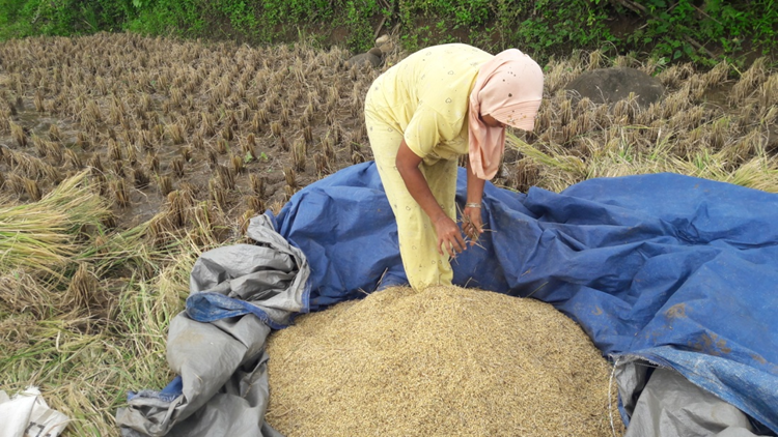
Still, women in Sirnabakti are not simply passive victims of this structure. Ratih, a 52-year-old former farm laborer who later worked for a local snack producer, said, “I worked all day as a farm laborer to support my children because their father was not around. But when I went to the fields, there was no one to take care of my children, and eventually they dropped out of school.” Her story captures both the burden women carry and the difficult negotiations they make between survival and care.
Women in the village are also central to household financial management, decisions about food purchases, and children’s education. Through religious study groups and women’s organizations such as the Family Welfare Movement Team (TP-PKK) and Women Farmers Groups (KWT), they have found platforms to articulate their concerns and negotiate their position within local power structures. These groups are not merely spaces for social gathering. They are also spaces for sharing knowledge about agricultural developments, building solidarity, and shaping collective demands. In that sense, the feminization of agriculture can also be read as a form of resistance: women’s collective participation in the domestic sphere, farming, and community organizations challenges dominant hierarchies of gender and class, even as those hierarchies continue to constrain them.
Also read: Hoe in the Right Hand, Book in the Left: How Indramayu Farmers Adapt to Extreme Weather
The technology women are kept away from
If women now sustain much of the agricultural economy in Sirnabakti, they still do so within boundaries that are both cultural and technological. Caroline Criado Perez wrote in her 2019 work on gender bias in technology, “We live in a world largely designed by men, for men.” That insight resonates strongly in rural agricultural life, where tools, technologies, and policies often take male bodies, male mobility, and male work patterns as the norm.
I was reminded of this while speaking with Kartini, or Tini, a 65-year-old former female laborer, in her weathered home. Sitting beside her granddaughter, she told us that women in the village are not allowed to operate certain agricultural tools, including rice milling machines and even motorcycles. These restrictions are not framed as questions of skill or safety, but as part of local cultural norms that limit women’s mobility and technological involvement in farming.
Those norms shape not only what women are allowed to use, but also the kinds of work they are expected to do. In Sirnabakti, women are generally excluded from tasks such as plowing, transporting rice, or hoeing, all of which are coded as men’s work. Instead, they are concentrated in tandur (planting), harvesting, and rambet (weeding). Yet this division should not be mistaken for evidence of lower ability. As Hasnah put it, “Women are often more agile and efficient in performing agricultural tasks. In fact, when working alongside their husbands, their efficiency can decrease because of the unequal task division.”
Tini’s family also shows how these restrictions are reproduced across generations. She told us that her daughter now works as a farm laborer, just as she once did. After Tini became ill, her daughter had little choice but to continue the work. As a single mother whose husband had migrated to the city and never fully resumed his responsibilities at home, she became the backbone of the family—earning an income, caring for her child, and looking after Tini at the same time. In other words, the burden carried by women in the village is not only agricultural, but also domestic and intergenerational.
That is why Tini’s hope for her granddaughter felt so significant. She wanted the child to pursue as much education as possible, so that she would not have to become a farm laborer like her mother and grandmother. Education, in this case, is imagined not simply as personal advancement, but as a possible way out of a cycle in which women inherit exhausting work, limited mobility, and little control over the tools that shape their livelihoods.
The problem, then, is not women’s capability. It is the existence of technological boundaries: limits on access to and use of technology created not by individual skill, but by social norms and design bias. Agricultural technologies are often developed with male perspectives in mind. Their ergonomic design, physical size, weight, and required strength are typically aligned with male physiology. Little consideration is given to women farmers, their work rhythms, or the domestic responsibilities that shape how and when they labor. As a result, women remain concentrated in labor-intensive, low-technology tasks despite their proven experience and efficiency.
Also read: Trapped Between Heat and Hunger in the Rice Barn: The Burden of Women Farmers in Indramayu
Beyond the fields, into the next generation
This matters not only for equality, but also for welfare. In August 2025, according to Indonesian Statistics Agency (BPS), the agricultural sector was the largest contributor to labor absorption in Indonesia, accounting for 28.15 percent. Given the sector’s enormous economic importance, gender inequality within agriculture is not a side issue. It is central to how welfare is distributed and withheld.
Addressing the multiple burdens borne by women farmers requires structural intervention. Gender-responsive policies are needed to formally recognize women as central contributors to agriculture. Equal wages, equal access to technology, and childcare support are essential if women’s economic position and political participation at the village level are to be strengthened. Without such changes, technological barriers will continue to deepen existing structural and cultural inequalities.
Those inequalities do not stop with income. They carry intergenerational consequences, shaping household welfare and children’s access to education. As Tini’s story makes painfully clear, the burden borne by one generation of women often sets the conditions for the next. Overcoming this is therefore not a short-term technical fix, but a long-term commitment in agricultural development.
As Indonesian heroine R.A. Kartini argued in her call for emancipation, women must be given equal opportunities to develop their capacities, because social progress cannot be achieved while women remain constrained by structural injustice. The women of Sirnabakti Village have long carried the fields, the household, and the future on their backs. The question is how much longer they will be asked to do so without equal access to wages, technology, and power.
Daniel Jeremia Natanael Nababan is a graduate of Sociology from State University of Jakarta and European Studies from University of Indonesia. He is engaged in research on gender and environmental issues at DEEP EnGender. He likes eating.
Illustration by Karina Tungari