Sunken Graves: Even in Death, Indramayu Residents Feel the Squeezed

In Reza Rahadian’s much acclaimed 2025 film Pangku, the Eretan Wetan Village in Kandanghaur District, Indramayu Regency, serves as a backdrop of the kopi pangku or kopi lendot (lap coffee). Dotted along the Pantura arterial highway on the northern coast of Java, the dimly lit roadside stalls offer coffee to traveling truck drivers and motorists served by scantily clad women often while sitting on their customers’ lap.
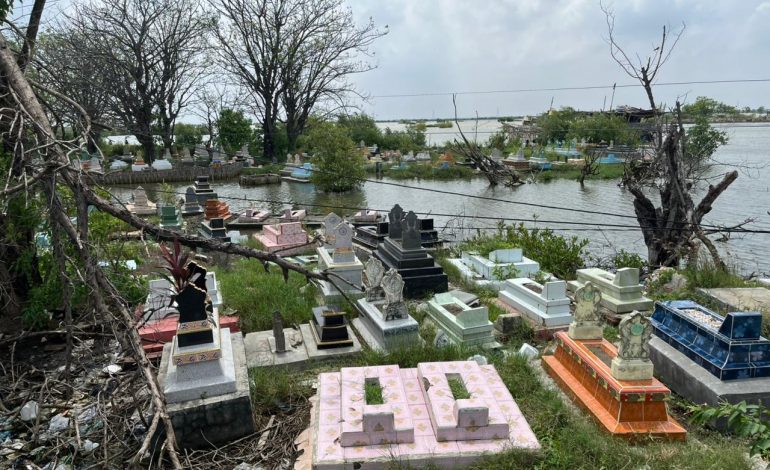
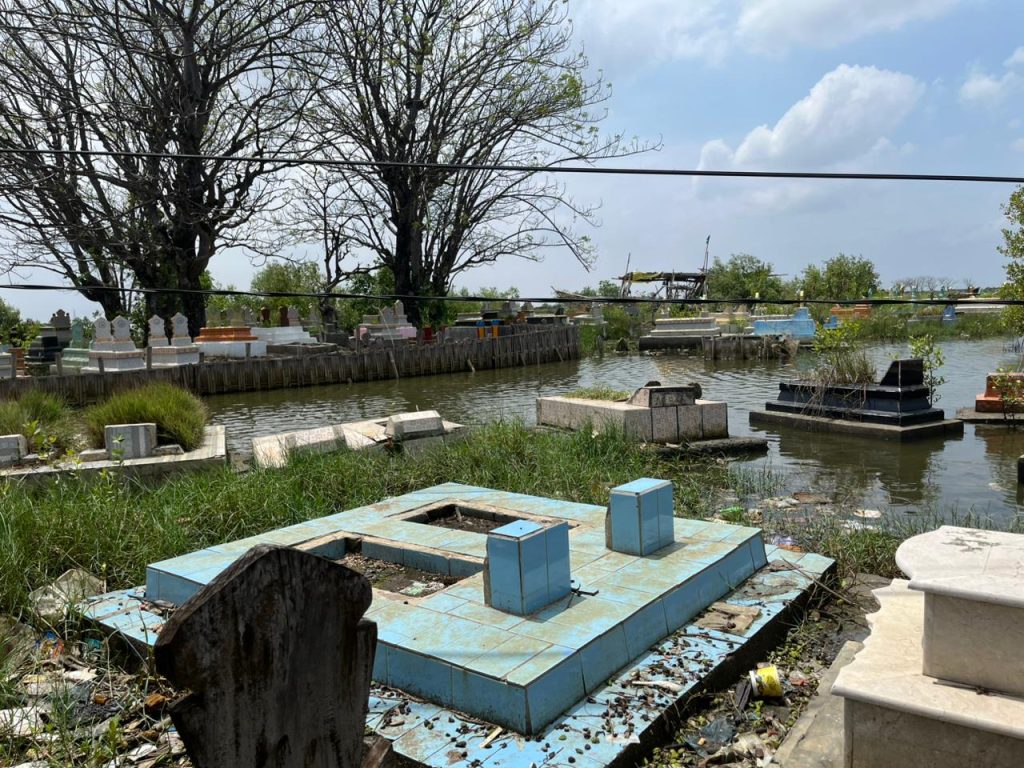
But for local residents, the most striking sight is the cemetery slowly sinking beneath the water. Covering two hectares of land, much of the surface of the public cemetery is now submerged. When I visited Indramayu late last year, only the tips of the gravestones were visible. Some stones leaned sideways, while others had disappeared—possibly swept away or submerged. Tall weeds obscured the boundaries between roads, land, and graves. Several areas were filled with brackish puddles, with piles of trash scattered in places.
That day, a villager had died and was about to be buried. Amid the standing water, residents once again prepared to carry out a task that has become increasingly common and difficult in the village: carrying the coffin through floodwater, digging a grave that would soon be inundated again, and burying the body in soft, waterlogged soil.
The home of one resident, Simin, 40, stands about 30 meters from the cemetery. From his front yard, the burial ground is clearly visible. I met Simin that afternoon. To enter his house, I had to walk around to the back. Several small wooden logs, about 60 centimeters in diameter, had been arranged loosely as stepping stones. The path was narrow, slippery, and unstable. I walked slowly to avoid slipping.
Read also: Climate Change Worsens Gender Inequality in Coastal Areas, Experts Say
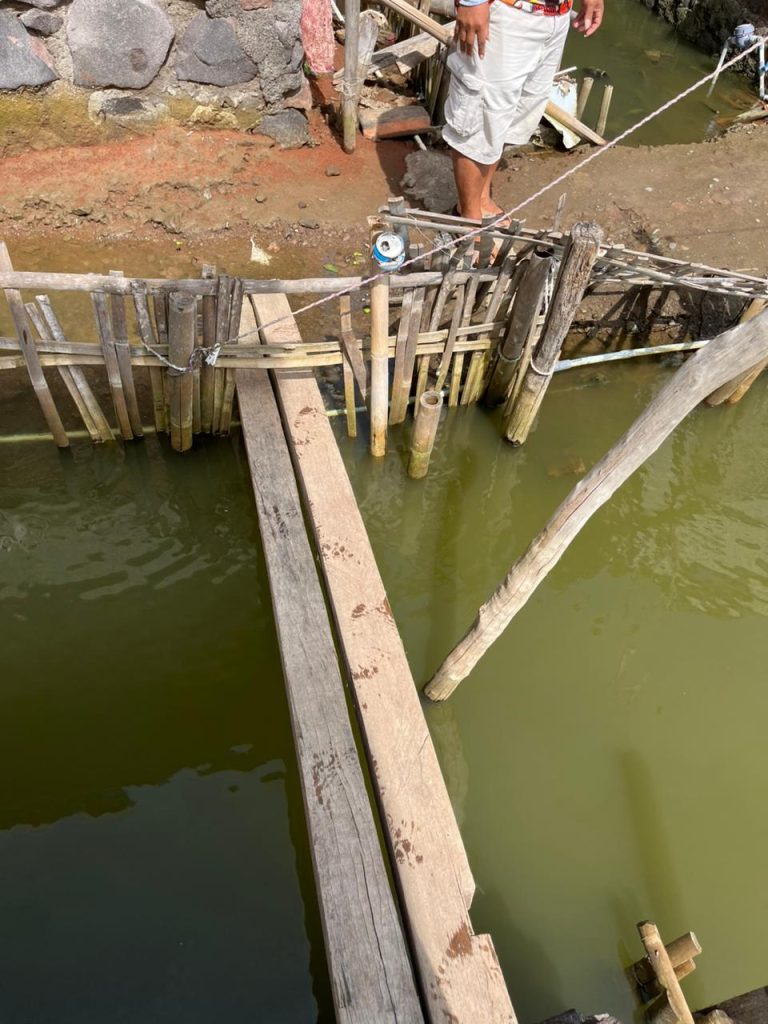
This path is something he crosses every day. It is hard to imagine how difficult it must be for elderly people, children, pregnant women, or people with disabilities. There is no alternative route, unless you swim.
That day, he had just finished helping his neighbors dig a grave. Simin, who also runs a YouTube channel, told me how difficult the digging process had become.
“When digging graves here, we have to drain the water first,” he said on Dec. 27, 2025. “We use buckets, ladles. If someone has a suction pump, we use it. But the water keeps coming back. Not all residents can afford to rent a pump, so sometimes bodies were buried even when the grave pit is still filled with water.”
According to Simin, burials in flooded graves are no longer rare. In recent months, this has been even a recurring event. Access roads to the cemetery are damaged or gone, and there is no lighting. Residents often cannot tell whether they are stepping on soil, road, or gravestones—the latter being considered sacriligous for most Indonesians.
“Sometimes we don’t even know if we’re stepping on a gravestone,” he said.
Simin moved to Eretan Wetan in 2010 after getting married. At that time, the village had not yet been regularly hit by tidal flooding. Overflowing seawater did not reach residential areas. Yards were dry, and rice fields, fish ponds, and salt ponds were still productive.
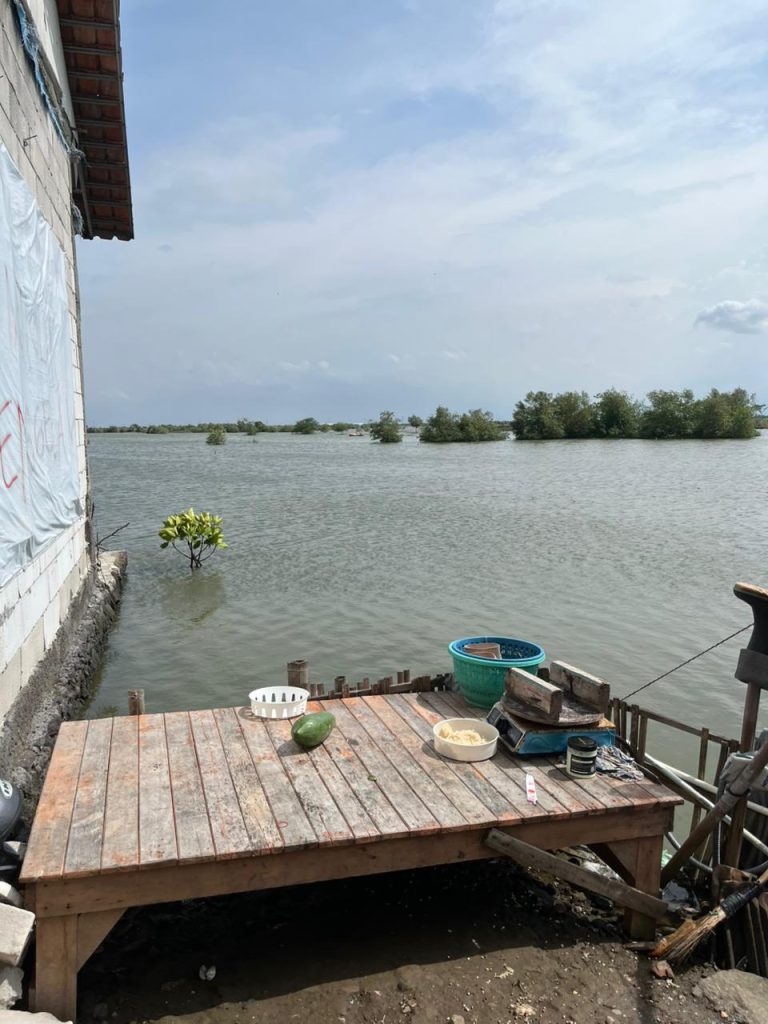
The change began after a major upstream flood in 2014. Although the water receded quickly, flooding began returning repeatedly. Conditions worsened around 2015 when a dam was built in the Soge River area, Bongas, to prevent saltwater intrusion into agricultural land.
Residents say the dam has instead worsened conditions in their village. When tidal floods come from the sea, the gates are closed. Conversely, when heavy rains fall in the south and upstream river discharge rises, water is directed toward coastal settlements. As a result, both tidal and rainwater become trapped and overflow into the village.
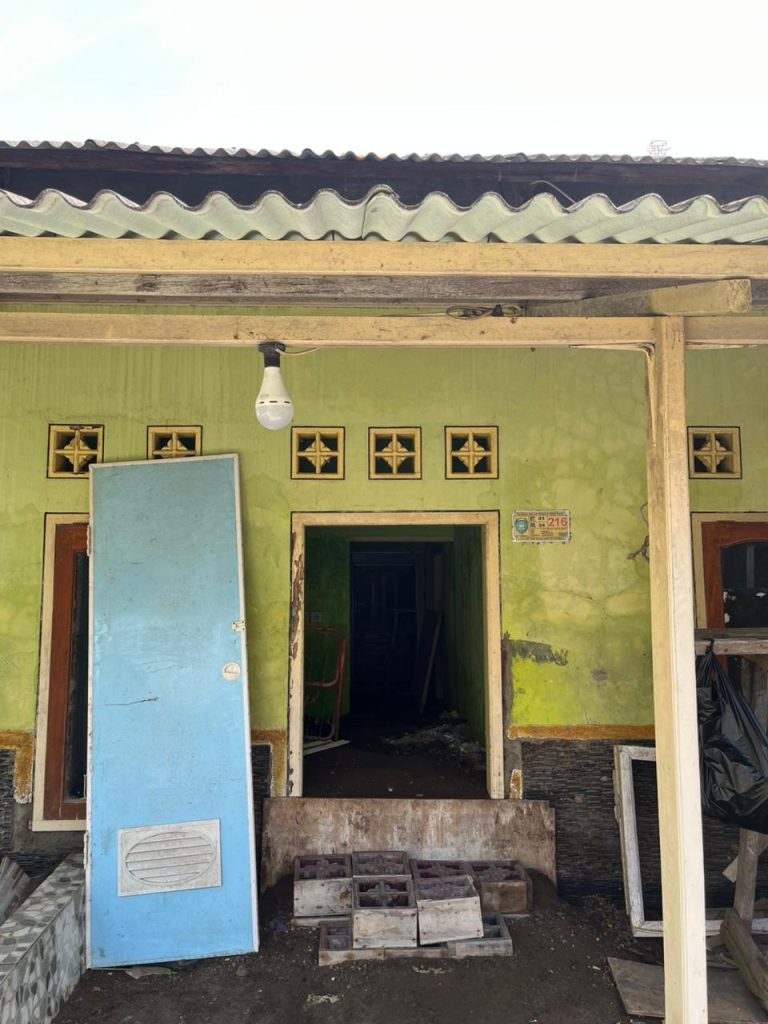
The major flood of 2021 became a turning point. At that time, Simin forced himself to return home, even though roads were closed. Water had reached chest height, forcing residents evacuated to a school for more than a week. Houses were submerged and many belongings destroyed. Simin’s kitchen, located at a lower level, was even swept away.
“That was my wife’s biggest loss,” he joked.
Since then, life in Eretan Wetan has changed completely. Tidal floods now come almost every day, sometimes twice daily. Water usually rises around 3 a.m., recedes toward noon, and rises again in the afternoon. There is no early warning system.
“If the water reaches the front door, that’s when we know we must get ready,” Simin said.
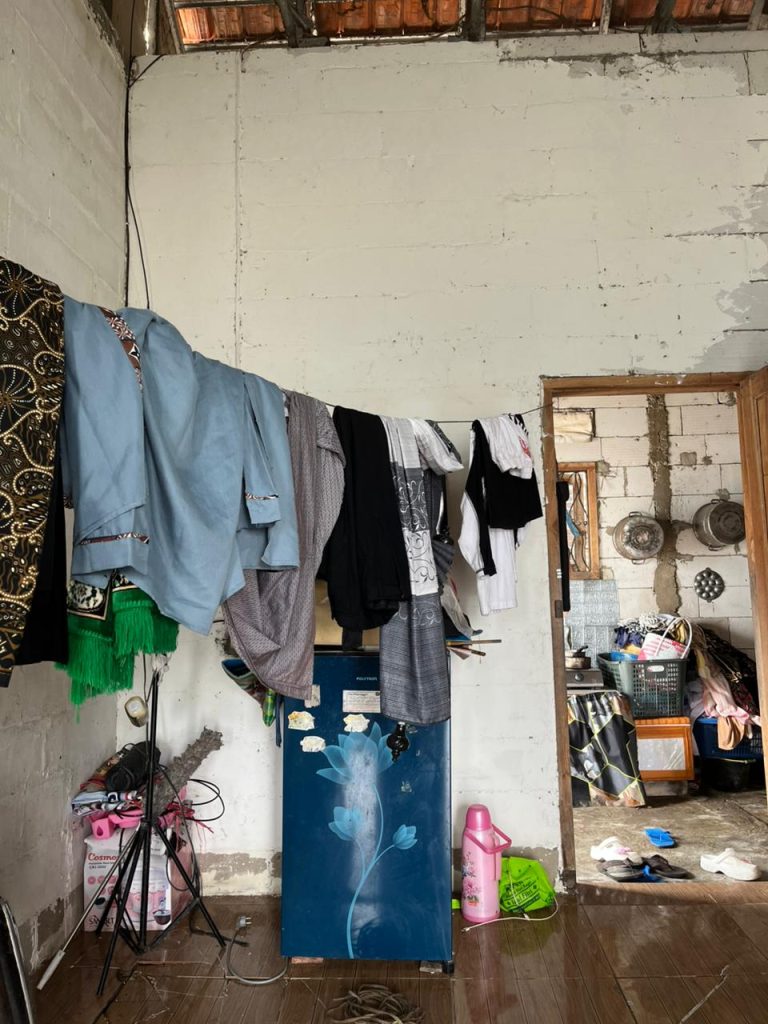
Belongings are lifted and hung, beds are raised with stacks of concrete blocks, but electronic appliances are almost always damaged. The television and refrigerator in Simin’s house no longer work and remain only as decorations. The house floor has cracked in many places.
Read also: Climate Crisis Triggers “Village Exodus” Along the Pantura—Where Is the State?
A Destructive Combination: Extreme Weather and Human Actions on the Coast
In recent years, tidal flooding has worsened as extreme heat becomes more frequent and prolonged. The dry season is no longer entirely dry but is marked by scorching daytime temperatures and high nighttime humidity. These conditions accelerate evaporation in ponds and salt fields, degrading water quality.
Eretan Wetan was once known as a fishing and salt-producing village. In better times, residents could earn up to about Rp1 million per day from marine products. Today, those livelihoods have nearly disappeared. Many residents now work as street vendors or catch small shrimp and crabs by boat, with uncertain income.
Simin works odd jobs while continuing to create content for his YouTube channel. Meanwhile, Supriyanto, a lifelong resident, has switched professions to become a street vendor—changes that have deepened local poverty.
Supri added that the increasingly frequent tidal floods are not only related to sea-level rise but also land subsidence. He pointed to coastal industrial activities, large-scale groundwater extraction, and shell dredging practices that have been taking place since around 2017. In a Dec. 27, 2025 interview, he said these activities were poorly supervised and never properly communicated to residents, despite their impact on seabed structure.
Read also: Trapped Between Heat and Hunger in the Rice Barn: The Burden of Women Farmers in Indramayu
Residents’ field observations align with findings by the Student Executive Council of the Pangeran Dharma Kusuma Islamic Institute in Indramayu. Its chair, Akmal Maulana, told me on Dec. 27, 2025, that river-mouth sedimentation, which is often cited as the main cause of tidal flooding, is only a surface symptom.
Based on student field investigations since 2017, large-scale dredging of scallop shells has occurred along much of the Indramayu coast. The affected area is estimated to stretch about 29 kilometers, from Patrol District to Cantigi.
Akmal explained that shell layers deposited over thousands of years function as natural barriers against wave energy. When these layers are dredged, coastal balance collapses and erosion intensifies. DEMA recorded hundreds of dredging boats operating daily in several locations, particularly in Parean Ilir, directly bordering Eretan Wetan.
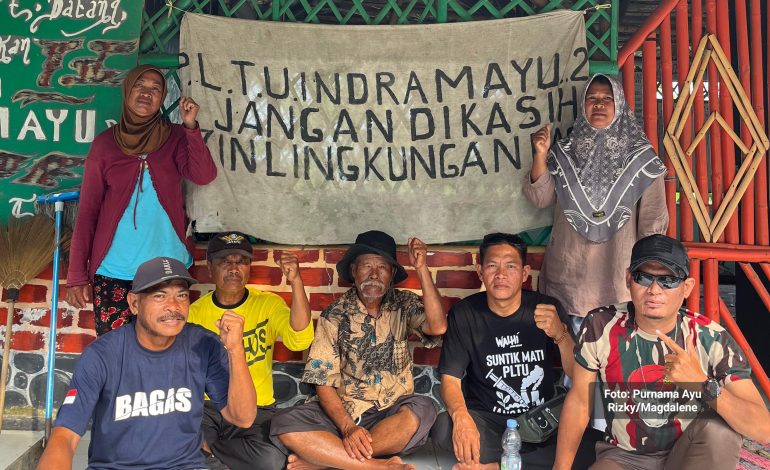
Residents have repeatedly protested. On June 23, 2025, around 300 residents, along with students, visited the local parliament and regency office. A meeting with the regent took place on June 26, 2025, during which the local government cited budget limitations and promised coordination with provincial and national authorities.
By October 2025, however, those promises had not materialized. According to Supri, residents later blocked the highway on Nov. 7, 2025. After the protest, heavy equipment was deployed to build temporary embankments in several residential areas, adjusted to the height of floodwaters.
Clearly, this is not a long-term solution. The Ministry of Public Works and Housing has identified Eretan as a priority area for coastal protection, including plans for a seawall and long-term coastal defense systems. Yet no permanent solution has been implemented, even after residents have lived with tidal flooding for eleven years.
Climate crisis, environmental exploitation, and coastal development policies that neglect communities have not only left destructive impacts in the area. Today, tidal flooding has not only damages homes and livelihoods, it has also robbed the localsh from their rights of being buried with dignity.
“Being an Indonesian citizen is hard–our living space is taken. Even after death, our space in death is stripped away,” Supri concluded.
Akmal Maulana and Try Utomo from the Indonesian Farmers Union (SPI) Indramayu assisted and supported this reporting.
This article is part of a reporting series supported by the Global Climate Resilience for All fellowship.