There is a sentence printed on the summons that ordered me to report to prison in Taiwan. It is in Chinese, so someone had to read it to me. It says: if you do not read Chinese, please bring your own translator.
I am writing for Indonesian workers in Taiwan, and for the families in Indramayu, Blitar or Lombok who may one day get a frightened phone call from them. I want to explain why that sentence should not exist, what the law actually promises, and what to ask for when the police or a court get involved. I am not a lawyer. I am a Canadian who ran a small English school in Taichung for fifteen years, and I am the person that sentence was printed for.
Read also: Trapped Between Heat and Hunger in the Rice Barn: The Burden of Women Farmers in Indramayu
In 2021, during a dispute with my landlord, I posted documents containing her personal data, including our lease. The courts found that some of the material stayed online for months. My account is that the lease was up for about two days, and that the witnesses I asked the court to call on that point were never summoned. I am not asking anyone to retry those facts here. Taiwan enforces its Personal Data Protection Act as a criminal law, and I was sentenced to six months in prison, final at the Supreme Court in October 2024.
What matters for you is the procedure. Over four years, through the police investigation, the trial and two appeals, no interpreter was ever appointed for me. Not one document was translated: not the indictment, not the judgments, not the papers that later took away my community-service alternative to prison. I could not read the judgments, and I learned what they said only in September 2026, almost two years after they became final.
This is not my word against the state’s. In December 2025, Taiwan’s Supreme Prosecutors Office confirmed both facts in writing, then declined to reopen the case because a legal-aid lawyer had been present at the first trial. That lawyer did not interpret, and I had no lawyer at all on appeal. If this can happen to a foreigner with savings, bilingual friends and fifteen years in the country, think about a caregiver alone in a hearing room after a night in a police station.
The law, at least on paper, is on her side. Taiwan wrote the International Covenant on Civil and Political Rights into domestic law in 2009. In 2020 it amended Article 99 of the Code of Criminal Procedure so that a defendant who does not understand Mandarin “shall” be given an interpreter. Not “may.” That right belongs to an Indonesian caregiver exactly as it belongs to me.
In practice, Taiwan’s National Human Rights Commission reported in April 2026 that foreign defendants are not always given an interpreter or translated documents in time, that no one checks whether the interpretation is accurate, and that migrant workers from Southeast Asia are the most affected. Indonesians are Taiwan’s largest migrant community, about 329,000 people. Yet no published figure shows how often courts actually appoint the interpreter the law requires. The state publishes detailed statistics on foreign defendants, by nationality and by outcome, and none on interpreters. A right that is never counted can fail silently, one caregiver at a time.
What to ask for
The gap between the law and the courtroom is closed by asking, in words an official cannot misunderstand. If you are a worker, memorize these. If you are family at home, read them to her over the phone.
Ask for an interpreter under Article 99, at the police station, at the prosecutor’s office and at every hearing. Say it in Indonesian and in whatever Chinese you have: “I do not understand Chinese. I request an interpreter under Article 99.” If a hearing goes ahead without one, tell the judge again and ask that your request be written into the record. The court must provide an interpreter. It is not a favor.
Ask for the indictment and any judgment to be explained to you through the interpreter, sentence by sentence, before you answer anything. Ask for copies of every paper the court gives you and keep them all, even the ones you cannot read. Photograph them and send them to someone who can.
Call 1955, the Ministry of Labor’s 24-hour hotline for migrant workers, which answers in Indonesian. It exists for exactly this moment.
Call your own office. The Indonesian Economic and Trade Office in Taipei (KDEI) has a citizen-protection function. Tell them you are facing criminal proceedings without an interpreter. A consular note asking why the law was not applied is something a court notices.
Ask the Legal Aid Foundation for its foreigner service by name. It offers telephone and video consultations with a lawyer, and legal aid for people who cannot afford one. Ask for your questions to be answered in writing.
Reach out to the migrant-worker centres. Church-run centres such as the Hope Workers’ Center in Zhongli have stood beside migrant workers in Taiwan’s courts for decades and know both the system and the people in it.
Watch the clock. A criminal judgment in Taiwan can be appealed only within twenty days of the day it is served on you. If it arrives in Chinese and you cannot read it, the twenty days run anyway. Treat every official envelope as a deadline until someone tells you it is not.
Read also: In Defense of Wicked Women: Color-synchronized Protests and the Delusion of Infallible Heroes
Taiwan chose to bind itself to the covenant when nobody required it to, and that is to its credit. It is also why this failure is so strange. And for the first time, a Taiwanese court has been asked to answer for it. On 10 September, the Judicial Yuan forwarded the Control Yuan’s referral of my complaint to the Taichung branch of the High Court, the court that tried my case, for a direct written reply.
That is a referral, not a finding, and I do not know what the court will say. But the question is now in front of the people who can answer it, and the answer will matter to every Indonesian worker who is ever led into a Taiwan courtroom without understanding a word.
Until then, the sentence on my summons remains the honest description of the system: bring your own translator. Ask for the one the law promises instead.
Ross Cline ran an English-language school in Taichung, Taiwan, for fifteen years and now lives in Phnom Penh, Cambodia. He is the defendant in the case described. The primary documents, including the Supreme Prosecutors Office’s letter of 22 December 2025, are indexed at iLearn.tw/newsbrief. He drafts with AI assistance from his own documents and verifies every fact personally; in 2025 he publicly relied on a mistranslation of one official letter and corrected the record after written clarification.
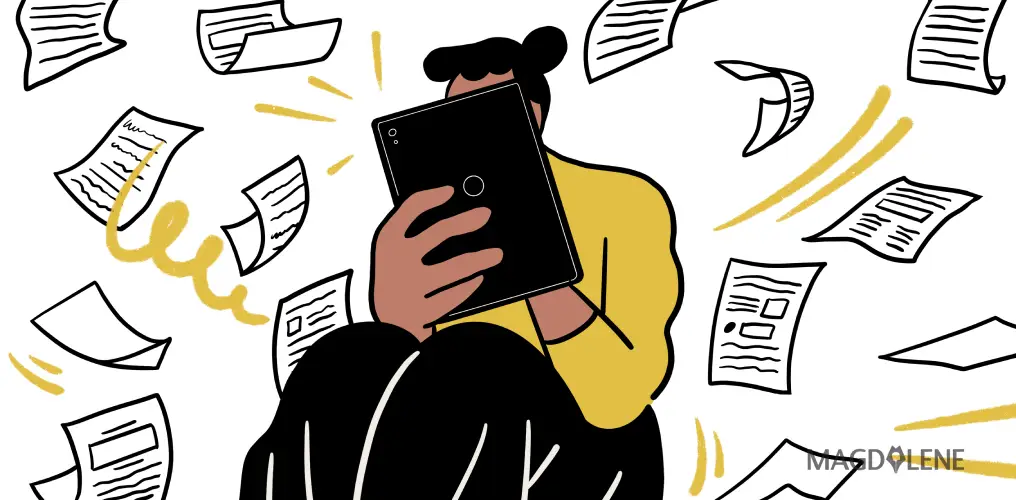
Illustration by Karina Tungari