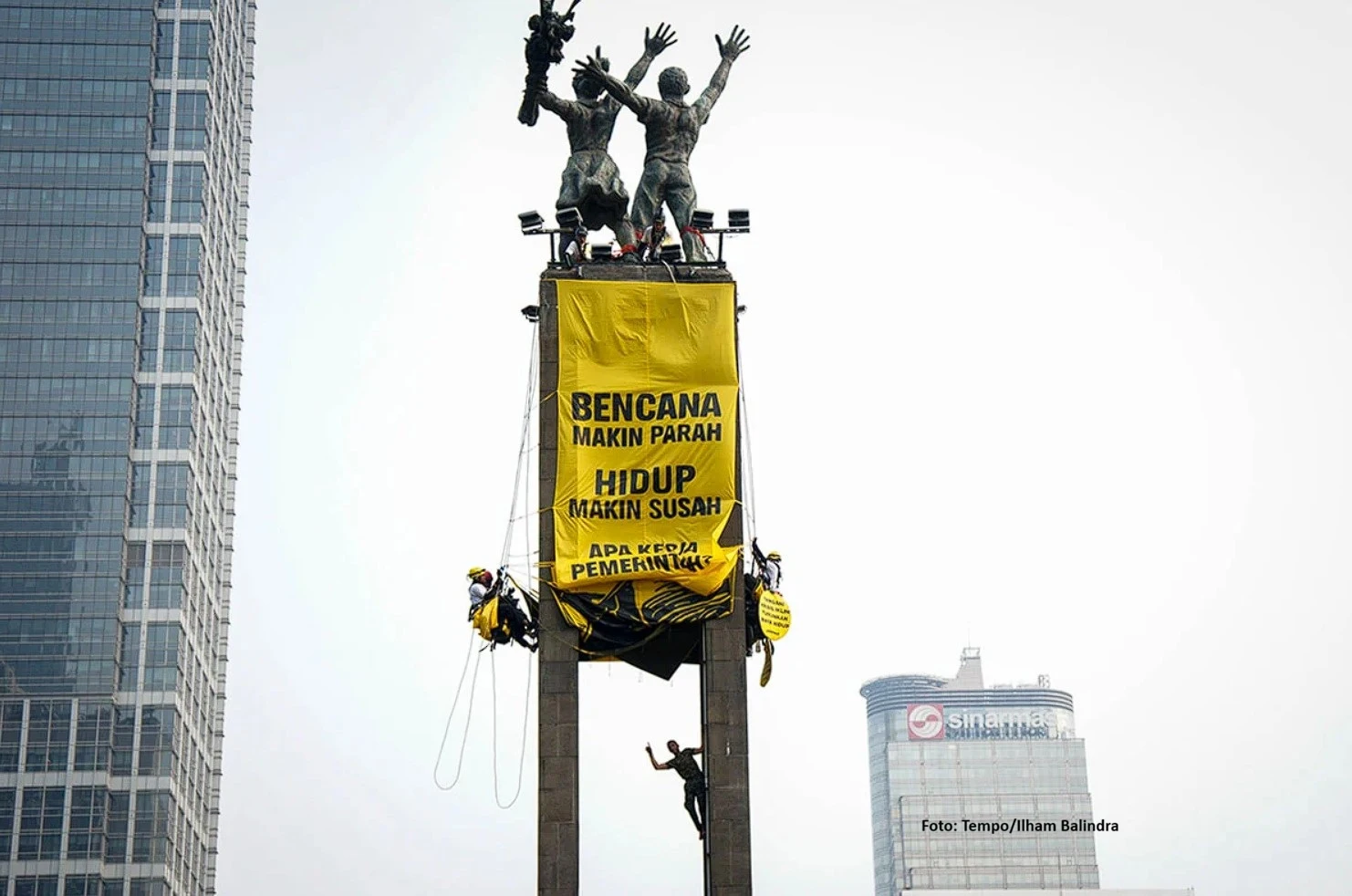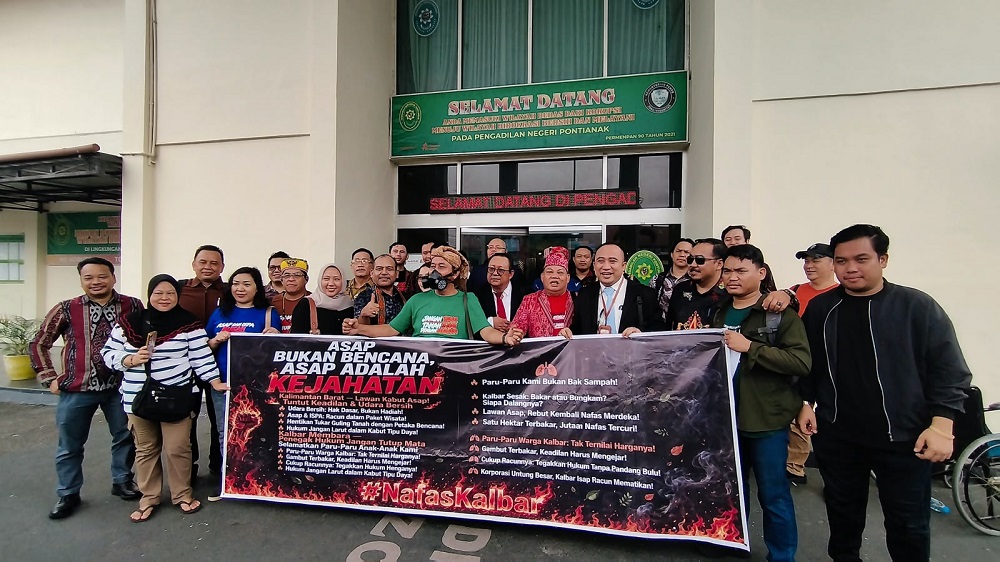
Three public demonstrations unfolded across Indonesia this August, each revealing a different face of public discontent.
In Garut, West Java, hundreds of residents from Banjarwangi, Singajaya, and Peundeuy protested roads so badly damaged that organizers half-joked about seceding from the regency. By afternoon, local officials had signed an agreement: a swift, hyperlocal response to an immediate grievance.
In Jakarta, the University of Indonesia’s student body (BEM UI) and allied student groups marched to HI Roundabout under the banner #MerebutKemerdekaan, one day after Indonesia’s 81st Independence Day. Their eight demands addressed national issues, including the controversial Free Nutritious Meals (MBG) program, cuts to regional transfers, agrarian reform, and the military’s growing role in civilian affairs.
Meanwhile, members of the Aliansi Masyarakat Pati Bersatu (AMPB) picketed their local council in Central Java and planned to march on the national parliament. They demanded the immediate passage of the long-stalled Asset Forfeiture Bill (RUU Perampasan Aset) and accountability for endemic local corruption.
Yet beyond these pockets of resistance, the country remains eerily muted.
This silence is striking because daily life has hardly become easier. The rupiah has weakened past Rp18,000 to the US dollar, while more than one million university graduates are unemployed. Some regional governments struggle to pay civil servants after central transfers were cut to help fund national programs, including MBG.
Tax authorities are looking to widen their reach to small rental businesses and informal vendors. High-profile corruption cases end in settlements or institutional stand-offs. Meanwhile, government rhetoric paints journalists and civil society workers as “londo ireng”—foreign henchmen—and suggests that critics should simply leave the country.
Amid these accumulating pressures, one question keeps surfacing at dining tables and across social media: why are most people still quiet?
Read also: Will Anarchism Face the Same Fate as Communism in Indonesia?
Must accountability begin with a death?
Indonesia remembers the 1998 Trisakti shootings. More recently, Affan Kurniawan, a 21-year-old ride-hailing driver, was struck by a police tactical vehicle during protests in August 2025. An independent fact-finding coalition later concluded that his death was an unlawful killing.
Before Affan’s death, protests over parliamentary allowances had shown little sign of spreading. Afterward, a multi-city, cross-class uprising erupted. A fatal state response transformed localized anger into nationwide unrest.
A healthy constitutional democracy should not need a body to activate its accountability mechanisms. But today’s relative quiet raises an unsettling question: are the streets calmer simply because there is no martyr?
The answer is more complicated.
Fear certainly matters. During the August 2025 protests, at least 6,719 people were arrested, including 2,573 minors, according to a fact-finding coalition that included human rights organizations KontraS, YLBHI, and LBH Jakarta. By early 2026, more than 700 people remained entangled in legal proceedings and 506 had been convicted.
The security posture was again visible at BEM UI’s August rally. A modest group of students was met by more than 9,000 security personnel, while 21 people were detained pre-emptively. Such displays of force inevitably make citizens think twice before stepping onto the street.
Fear alone, however, does not explain why so many ordinary citizens withdraw from political life. A deeper force may be at work: collective exhaustion.
After years of watching institutions deteriorate, people can reach the limits of their emotional and cognitive capacity. They still recognize the absurdity around them, but may have redirected their remaining energy toward survival.
Material precarity can therefore act as political containment even without an explicit master plan. Cash assistance (bansos) and free school meals may provide essential relief, but they cannot substitute for structural reform. Nor should the state mistake the absence of revolt for genuine trust.
The contrast between Garut and Jakarta is instructive. It is easier to mobilize people around a broken road they use every day than around a list of complex national demands. The first has a visible problem, a clear target, and a tangible solution. The second requires people to connect budgets, institutions, rights, and long-term consequences.
That gap also raises questions about Indonesia’s education and media ecosystems. Do they equip citizens merely to read and vote, or to understand how power operates? An electorate may be literate yet still lack the time, resources, or political education to scrutinize the spectacle presented to it.
Indonesia has seen this kind of quiet before. Under the New Order, the state imposed the “floating mass” (massa mengambang) policy, restricting political parties from organizing below the district level and pushing ordinary citizens away from everyday political participation. No equivalent decree exists today. Yet economic insecurity, cognitive exhaustion, and political intimidation can produce a similar result: a population floating not by formal mandate, but because daily survival leaves little room for democratic engagement.
A crowd is not a mandate
The government has been quick to frame public quiet as endorsement. After the BEM UI demonstration, Cabinet Secretary Teddy Indra Wijaya responded not to the students’ policy criticisms but by citing the crowds at Independence Day celebrations: more than 150,000 people at the presidential palace and up to 500,000 along the carnival route. Their attendance, he argued, showed that the public loved and supported the government.
But counting parade-goers is a poor measure of political sentiment. People may attend for free food, entertainment, or community. Likewise, protest size does not necessarily reflect the depth of public anger. Street turnout shows who can be physically present—not everyone who is dissatisfied.
Indonesia should not need a martyr to awaken its democratic conscience, nor should citizens have to reach starvation before demanding basic governance. When people live with dignity—without constant anxiety over food, housing, health care, or tuition—they have more capacity to monitor the state, challenge bad policy, and choose their representatives carefully.
The central question for Indonesia’s democratic future, then, is not whether silence means consent. It is whether citizens will ever be given enough security, education, and political space to demand more—and whether the state truly wants them to.
Monica Kappiantari is an ordinary Indonesian citizen (WNI) observing Indonesia’s evolving democracy after living through the New Order, the promise of Reformasi, and today’s current political landscape.